

This post is part of our complete guide to Car Accident & Whiplash Treatment in Las Vegas. Browse the guide for more in-depth information on treatments, symptoms, and recovery in Las Vegas & Henderson.
The First 72 Hours to Full Recovery: Our Step-by-Step Crash-to-Rehab Pathway
Our car accident recovery timeline chiropractic pathway Las Vegas approach is a structured, four-phase plan we use to move you from the first painful 72 hours after a crash to confident, normal activity again. We focus on identifying what’s injured, protecting healing tissues, restoring motion, rebuilding strength, and then returning you to the life you had before the accident. At Southern Nevada Chiropractic Car Accident Treatment Centers, we built this pathway because pain relief isn’t the finish line—full function is.
Why we use a structured recovery timeline (and why “feeling better” isn’t the same as “being recovered”)
After a car accident, it’s common to think recovery is simple: pain shows up, you get treatment, pain goes away, and you’re done. But in real life, injuries—especially whiplash-type injuries and back strains—often follow a predictable pattern:
- Symptoms can change over the first few days.
- Inflammation can mask or amplify what you feel.
- You can feel “mostly fine” and still have reduced range of motion, weakness, or poor coordination.
- Returning to work, driving, gym time, or playing with your kids can expose what’s still not fully healed.
That’s exactly why we rely on a car accident recovery timeline chiropractic pathway Las Vegas plan instead of random, symptom-only care. We want you to heal safely and completely—so you’re not stuck in a cycle of flare-ups months later.
Suffering from pain after an accident? Southern Nevada Chiropractic offers same-day appointments in Las Vegas & Henderson. Call Now →
What makes our crash-to-rehab pathway different at Southern Nevada Chiropractic
Our clinics in Las Vegas and Henderson are led by Dr Michael Reiss DC, and our care model is designed around progression—not just relief. We don’t try to “see how much the body can tolerate” in the early days. We aim to create the safest conditions for healing, and we only layer in more active work as your tissues and nervous system are ready.
Depending on what you need, care in our centers may include:
- Therapeutic exercise and stretching
- Spinal traction
- Manual soft tissue therapy
- Transcutaneous electric nerve stimulation (TENS)
- Nutritional counseling and lifestyle modification
- Chiropractic adjustments (including low-force techniques when appropriate)
All of that fits inside a clear, four-phase car accident recovery timeline chiropractic pathway Las Vegas—so you understand what we’re doing and why.
The 4 phases of our car accident recovery pathway (overview)
We guide patients through four distinct phases:
- Protect (first 72 hours): identify injury, rule out serious issues, calm symptoms, protect tissues
- Restore (early weeks): reduce pain/inflammation and progressively restore normal movement
- Rebuild (mid recovery): transition from passive care to active recovery—strength, endurance, coordination
- Return (late recovery): test and reintroduce normal life—work, driving, exercise, family activities
Below, we’ll break down what each phase typically looks like, what we’re monitoring, and what you can do at home to support your results. This is the heart of our car accident recovery timeline chiropractic pathway Las Vegas approach.
Phase 1 (first 72 hours): Protect
The first 72 hours after a crash can be confusing. Adrenaline is high, soreness can be delayed, and you may not yet know what’s minor versus what needs urgent attention. In our car accident recovery timeline chiropractic pathway Las Vegas, this “Protect” phase is about safety first.
Our goals in the Protect phase
- Identify what’s injured (not just where it hurts)
- Rule out red flags and serious problems
- Control symptoms early (pain, stiffness, headaches, dizziness)
- Protect injured tissues so healing can start cleanly
What we do during the first 72 hours
We begin with a thorough evaluation designed to understand the mechanism of your accident and how it affected your body.
- Detailed history: what happened, how you felt right after, and what’s changing day by day
- Neurological and orthopedic exams: strength, reflexes, sensation, and orthopedic stress tests as appropriate
- Concussion symptom screening when clinically indicated (especially if you hit your head or had sudden acceleration/deceleration)
- Referral coordination when needed to ensure you get the right level of care
- Imaging decisions: we consider imaging when clinically indicated—not by default, and not as an afterthought
In other words, during Protect we’re not trying to do “maximum” treatment. We’re trying to build a precise, safe plan so you don’t accidentally push a vulnerable structure too early.
Common injuries we’re watching for right away
Every crash is different, but these are common patterns we see in Las Vegas and Henderson auto accident patients:
- Whiplash-associated disorders: neck pain, headaches, stiffness, shoulder or upper back tightness
- Thoracic or lumbar sprains/strains: mid-back or low-back pain, spasm, pain with bending
- Joint irritation or subluxations (movement dysfunction)
- Disc-related problems such as bulges/herniations (when present, symptoms can include radiating pain, numbness, tingling)
- Soft tissue injuries: strained muscles, irritated ligaments/tendons
- Nerve irritation: altered sensation or weakness requires careful monitoring
What we often recommend at home in the first 72 hours
We tailor guidance to your exam findings, but in general, our early recommendations focus on reducing aggravation and supporting calm, safe motion.
- Keep movements gentle and within tolerance—avoid “stretching through” sharp pain.
- Pay attention to sleep position and posture (poor positioning can ramp up neck and back symptoms quickly).
- Track changes: pain locations, headaches, dizziness, numbness/tingling, sleep disruption.
- Follow any medical guidance you’ve been given (and let us know about medications or restrictions).
If anything feels like it’s getting worse rather than better, that’s a reason to be evaluated—not a reason to “wait it out.” Early clarity is part of a smart car accident recovery timeline chiropractic pathway Las Vegas.
Phase 2 (early weeks): Restore
Once the initial 72-hour inflammatory stage starts to settle, we shift into Restore. In our car accident recovery timeline chiropractic pathway Las Vegas, this is where we work to decrease pain and inflammation while gradually bringing normal movement back online.
Our goals in the Restore phase
- Lower pain levels and calm persistent inflammation
- Restore range of motion in the neck, back, and affected joints
- Improve tissue tolerance so normal daily tasks stop triggering flare-ups
- Monitor progress and investigate further if recovery stalls
What care often looks like in Restore
Because the acute phase is passing, we can typically do more than we could in the first 72 hours. We may incorporate:
- Low-force adjusting techniques when appropriate
- Soft tissue therapy to reduce muscle guarding and improve mobility
- Gentle stretching and mobility drills
- Range-of-motion exercises that you can repeat safely at home
- TENS for symptom modulation when helpful
- Spinal traction as clinically appropriate for certain presentations
This phase can be a turning point: many patients begin to feel meaningful relief. But we also stay alert—because relief alone doesn’t prove the injury is fully resolved.
When we consider MRI or specialist co-management
If you’re not progressing as expected, we don’t guess. This is the stage where we may:
- Order or request MRI when clinically indicated
- Refer for neurological or orthopedic evaluation when the exam suggests it
- Coordinate care and co-manage with pain management when appropriate
We do this for one reason: we want the pathway to stay safe and accurate. A responsible car accident recovery timeline chiropractic pathway Las Vegas includes escalation steps when the clinical picture calls for it.
What you can do to support Restore at home
- Do the prescribed mobility work consistently—small daily wins matter more than occasional big efforts.
- Avoid long, uninterrupted sitting when possible; gentle movement breaks can reduce stiffness.
- Prioritize sleep quality (it’s one of the biggest recovery multipliers we see).
- Stay hydrated and follow nutritional guidance if we’ve provided it—tissue repair is a metabolic process.
Phase 3: Rebuild (from passive care to active recovery)
Rebuild is where many people get tempted to stop—because they’re finally feeling better. But in our experience, this is the phase that determines whether your recovery holds up in real life. In our car accident recovery timeline chiropractic pathway Las Vegas, Rebuild is where we shift from “getting you comfortable” to “getting you capable.”
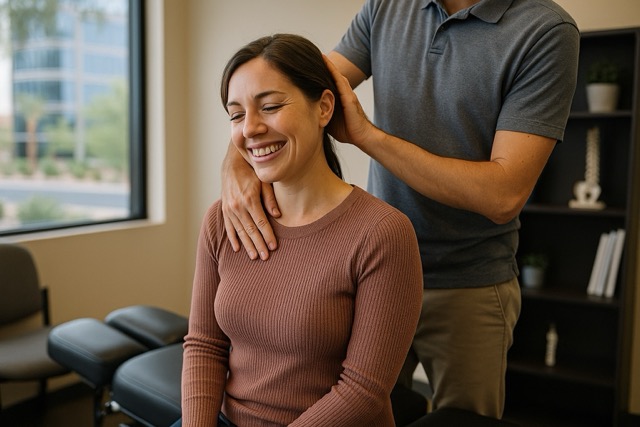
Our goals in the Rebuild phase
- Transition away from passive care and toward active recovery
- Restore strength, endurance, and coordination
- Improve posture and movement patterns that may have changed due to pain
- Build confidence in your body again
Why pain reduction can be misleading
Here’s what we tell patients every day: pain is a signal, not a complete report card. You can have low pain and still have:
- Reduced deep neck or core stability
- Poor endurance (you’re fine for 2 hours, then you crash)
- Compensations (you move around the injury instead of through normal mechanics)
- Deconditioning from weeks of guarding and reduced activity
That’s why we take Rebuild seriously—because we want you driving, working, lifting, and sleeping normally without constantly “managing” your injury.
What we add in Rebuild
Rebuild typically includes more progressive work, such as:
- Postural retraining (especially for desk workers and drivers)
- Functional movement training (hinging, reaching, squatting mechanics as appropriate)
- Progressive resistance to rebuild tissue capacity
- More advanced home exercises with clear progressions
- Lifestyle modifications to remove common “re-injury triggers”
In this phase, we’re not just treating an injury. We’re working with you to rebuild your life—and to make sure the progress you’ve earned is durable. That’s the purpose of our car accident recovery timeline chiropractic pathway Las Vegas.
Phase 4: Return (back to normal activity without fear)
Return is the final phase—where we help you resume the activities that matter to you. For some people, that means getting back to the gym. For others, it’s hiking, biking, golfing, or simply picking up a child without bracing for pain. In our car accident recovery timeline chiropractic pathway Las Vegas, Return is about testing real-life function.
The “real life” questions we ask in Return
- Can you drive comfortably?
- Can you work a full day without pain spikes?
- Can you sleep normally without waking up stiff or sore?
- Are you back to your usual activities (like golf, gym, or playing with your kids) without constantly thinking about the injury?
When the answer is consistently “yes,” that’s what we consider full recovery: not just fewer symptoms, but restored function and confidence.
How we help make Return safe (not rushed)
Return doesn’t mean “do everything at once.” It means a smart ramp-up. We may:
- Increase movement complexity and load gradually
- Use targeted mobility and stability work as “maintenance”
- Adjust the home plan to match your sport, job demands, and daily routines
This is also where our Las Vegas and Henderson teams at Southern Nevada Chiropractic Car Accident Treatment Centers keep an eye on the details that cause setbacks—like posture, repetitive stress, and insufficient recovery between activity days.
A practical “timeline” view: what many patients experience (and what’s normal)
Every case is individual, but here’s a simple way to think about a typical progression. This is not a promise or a guarantee—just a helpful way to understand the flow of our car accident recovery timeline chiropractic pathway Las Vegas.
- Days 0–3 (Protect): symptoms may be evolving; our focus is safety, assessment, and calming the system.
- Weeks 1–3+ (Restore): pain typically begins to trend down; motion begins to trend up; we watch closely for stalls.
- Weeks 3–8+ (Rebuild): strength/endurance become the focus; we reduce dependency on passive therapies.
- Later weeks (Return): we prove you can live normally again—driving, working, exercising, and sleeping well.
Your exact timeline depends on many factors (impact severity, prior injuries, job demands, sleep, stress, and consistency with home care). The point of the pathway is that you always know what phase you’re in and what we’re aiming for next.
What to watch for after a crash (especially if symptoms are delayed)
It’s common for people to feel “okay” at first and then develop symptoms later that day or over the next few days. If you notice any of the following, it’s a good idea to get checked promptly:
- Neck pain, stiffness, or reduced ability to turn your head
- Headaches (especially new headaches after impact)
- Mid-back or low-back pain
- Pain that radiates into an arm or leg, numbness, tingling, or weakness
- Dizziness, nausea, light sensitivity, or “foggy” feeling (possible concussion symptoms)
- Sleep disruption due to discomfort
Getting an early, structured assessment is one of the simplest ways to prevent weeks of uncertainty. It’s also how we set the foundation for the car accident recovery timeline chiropractic pathway Las Vegas we use with our patients.
How our services fit into the pathway (neck pain, back pain, whiplash, and more)
Our centers treat many common post-accident complaints throughout Las Vegas and Henderson, including whiplash injuries, neck pain, and back pain. The key is that we don’t treat these as isolated problems—we treat them as part of a system affected by trauma and compensation.
Neck pain and whiplash: why range of motion and stability both matter
Neck pain after a crash can limit mobility in the neck, head, shoulders, arms, and upper back. It can also contribute to headaches. We often see contributing factors such as trauma (whiplash), posture, repetitive stress, joint issues, or muscle strains.
In our pathway, we aim to:
- Calm pain early (Protect/Restore)
- Restore motion safely (Restore)
- Rebuild stability and endurance (Rebuild)
- Return you to driving, work, and exercise without flare-ups (Return)
Back pain after an accident: don’t ignore the underlying mechanics
Back pain can come from sprains/strains, disc bulges/herniations, joint movement problems, muscular guarding, and irritated nerves. Chiropractic care can be beneficial for many of these presentations, especially when paired with exercise, stretching, and lifestyle modifications.
We’ll always match the tool to the phase. That’s why having a car accident recovery timeline chiropractic pathway Las Vegas matters—what helps in week one is not always what you need in week six.
How we measure progress (so you’re not guessing)
We like clear milestones. Depending on your case, we may track:
- Range of motion improvements (neck, thoracic spine, lumbar spine, shoulders/hips)
- Functional tolerance (sitting, standing, walking, work tasks)
- Sleep quality and morning stiffness
- Strength and endurance markers (appropriate to your baseline)
- Symptom consistency (fewer spikes, quicker recovery after activity)
Progress isn’t always perfectly linear, but you should see a trend in the right direction. If you don’t, our pathway includes steps to reassess, escalate diagnostics when indicated, and co-manage when needed.
Key Takeaways
- Our car accident recovery timeline chiropractic pathway Las Vegas is a four-phase plan: Protect, Restore, Rebuild, and Return.
- The first 72 hours (Protect) focus on identifying injuries, ruling out serious issues, controlling symptoms, and protecting tissues.
- Restore emphasizes lowering pain and inflammation while safely bringing motion back.
- Rebuild is where we transition from passive care to active recovery—strength, endurance, coordination, and posture.
- Return is about real-life function: driving comfortably, working full days, sleeping normally, and doing your usual activities again.
- Southern Nevada Chiropractic Car Accident Treatment Centers serve patients across Las Vegas and Henderson with evidence-informed exams, therapeutic exercise, soft tissue care, traction, TENS, and lifestyle guidance—matched to the right phase.
Where to Go From Here
If you’ve been in a crash and you’re not sure what to do next, we can help you make the next step simple and safe. call today to schedule your accident help so we can evaluate your injuries, protect your recovery, and map out your next phase using our proven four-step process at Southern Nevada Chiropractic Car Accident Treatment Centers. The sooner we start the right car accident recovery timeline chiropractic pathway Las Vegas, the easier it usually is to prevent setbacks and get you back to normal life.
Frequently Asked Questions
What should I do in the first 72 hours after a car accident if I feel sore later?
In the first 72 hours, we focus on protecting injured tissues and getting clarity on what was affected. If soreness shows up later, it’s still important to get evaluated so we can identify the injured structures, screen for neurological or concussion-related concerns when indicated, and guide safe early movement instead of guessing.
Why does your clinic use a four-phase recovery plan instead of only treating pain?
Pain relief is important, but it isn’t the finish line. Our four phases—Protect, Restore, Rebuild, and Return—help ensure you regain motion, strength, endurance, coordination, and real-life function so you can drive, work, sleep, and exercise normally again.
When would you recommend imaging like an MRI after an auto accident?
If you’re not progressing as expected or your exam findings suggest a deeper issue, we may recommend MRI when clinically indicated. We can also coordinate referrals for neurological or orthopedic evaluation and co-manage with pain management when appropriate.
What treatments might be included in your Las Vegas and Henderson car accident chiropractic care?
Depending on your phase of recovery and exam findings, care may include low-force adjusting techniques, manual soft tissue therapy, therapeutic exercise and stretching, range-of-motion work, spinal traction, TENS, and lifestyle or nutritional guidance.
How do you know when someone is ready to return to normal activities after a crash?
In the Return phase, we look for consistent real-life function: driving comfortably, working full days without pain spikes, sleeping normally, and doing normal activities like gym, hiking, biking, or golf without constantly thinking about the injury.
Ready to Feel Better?
Our Las Vegas & Henderson chiropractors are ready to help — same-day appointments available.

Dr. Michael Reiss, DC has practiced chiropractic in Las Vegas since 1998. A graduate of Life Chiropractic College West, he founded Southern Nevada Chiropractic to specialize exclusively in car accident and injury recovery across the Las Vegas Valley.
He is the author of The Las Vegas Car Accident Victim’s Health Guide and contributes to The Modern Physician Letter, a national publication for medical doctors.
His clinics have earned 2,000+ five-star Google reviews across 9 Valley locations.
Originally spoken aloud by Dr Michael Reiss DC. Edited with AI assistance and reviewed before publication.
Further Reading: Whiplash Treatment
- Stuck After Physical Therapy? What to Do When Your Recovery Plateaus
- Will You Keep Treating Me Just Because I Have a Claim? How We Avoid Overtreatment
- Multi-Car Pileups and Multiple-Impact Crashes: Why They’re Different and Harder to Treat
- Beyond Pain Relief: What Real Long-Term Recovery and Getting Back to Function Looks Like
- Numbness, Tingling, and Shooting Pain Into Your Arm After a Crash
→ Complete Guide: Car Accident & Whiplash Treatment in Las Vegas